by Erin Slaughter
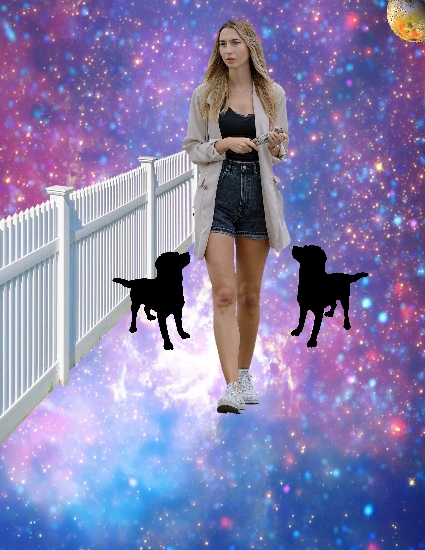
She stands in the middle of the empty sidewalk, struggling to unfold the plastic seam of the dog poop bag with her winter hands. Fingers chapped, clunking, white as a spoiled bonfire. She accepts the necessary gospel of lotion but has not yet managed to put it into practice. She is thirty, the oldest a young person can be; the youngest an old person can be. Trucks with protrusive jaws roar down the little street and her dog flails from his leash, yowling at the gray air.
When people who have not seen the dog ask what kind of dog she has, she never quite knows how to explain him. Sometimes she answers, “It’s what you imagine when you hear that song, ‘How Much is That Doggy in the Window?’” But everyone seems to imagine different things. Sometimes she answers, “Medium-small.” His ears flop back in the wind, his expression that of a cowboy countenancing the distance, weathered and dignified.
As she walks toward the dog park at the midcentury edge of the neighborhood, she is still thinking about the man on TV. The man was an actor giving an interview about his inspirations, his journey to the actualization of his dreams. He was handsome, of course, but a flavor of handsome she can tolerate. The words that spilled from his tender lips were like paintings people pay to stand in rooms and stare at. She, like the man on TV, paid her birthright plus some for finely framed pieces of paper. She knows so many words, and what has it gotten her? She is not on TV.
Her life could be considered idyllic, if she were a retiree. But she is thirty and not yet ready to give up on the things in life people eventually give up on. Sometimes she sees a dog and a visceral voice inside her says I want to pet that dog, and then she usually gets to. She imagines it’s an intimate window into how billionaires feel, the barely-present blip of time between desire and attainment.
***
It’s New Year’s Eve, which she plans to spend with a friend from her job, a person called Henley. When she took the job in the admissions office of the small local college, she figured you have to spend up the years of your life somehow. Most of her job is answering emails from young people in foreign countries begging for release from their lives. Greetings of the day, they are addressed. They often request waivers for the fifty-dollar application fee. In the exchange rate of my country, understand this is a year of my family’s salary; My country is at war, understand this is my one chance for a better life; Understand, without this, there is no future.
She writes back: Unfortunately, the fee is not negotiable. It’s the template response her job provided. She can’t help but feel that, cumulatively, the template and her act of sending it is adding to the net suffering in the world. She told this to her boss, who allowed her to add the Unfortunately. Henley’s job in the admissions office is scholarships, setting off a confetti cannon of hope, not stripping it away.
The town is a little nothing on the precipice of the actual ocean. Everyone there walks around with the Bible in their heads. The only thing people there want is to be drunk on a boat. There is no one, almost no one, she would go onto a boat for. She doesn’t think about God too much, these days. Being in love is the main thing that would make her think about God.
The heron makes her think of God, of love, of livings and dyings. At the dog park, there is a pond, and on the tangled brush island at the center of the pond there is often a heron. Seeing the bird brings on a swooning ache she can’t explain. The steady truth of its pale blue eye is a frantic animal lapping at her heart. She feels as if the heron is someone she knows from a past life, perhaps the only person she has ever known in any life. Hildegard of Bingen said eating a heron’s heart is a remedy for heartbreak—she read that somewhere, long ago, while she was earning her framed pieces of paper. When the labs and rotties lunge through the green water snapping their jowls at the bird, she turns her face away, sickened.
***
The heron is not there when she arrives at the dog park on New Year’s Eve. A pair of swans float in the pond instead. Swans are hot mean-girl geese, she types out on her phone, sends to no one. It’s a gated stretch of leaf-ridden land, empty except for the tall man.
The tall man at the dog park is a regular. She had a conversation with him once, when he moved to sit beside her on the bench where she had been sitting first. The tall man had told her about being a medical missionary in Ukraine. When he started talking, she thought she was entering one of those old kinds of stories, in the era when people had random earnest encounters with strangers on a daily basis.
He told her about the war, and the decimated villages, and a bomb shelter under an opera house. She felt she was receiving something valuable from this exchange. She asked what the air raid siren sounded like, and he just said it was loud.
She asked, “Like a tornado siren, or?”
He paused for a long moment, as if attempting to approximate the memory for her, then gave up and said, “Just loud.”
She was disappointed. Sort of annoyed at him. So she avoided him now. It’s smart to keep one’s catalog of acquaintances thin. If you got to know too many people, you started to feel surveilled. The most blissful days she’d spent in this town were the first ones, before she started her job, when she didn’t know anyone and no one knew her. She didn’t even know herself—which aggregate of characteristics would come forth to form the self she’d inhabit in that place. Now she’d lived in the town long enough to find out. Finding out isn’t what it’s cracked up to be.
The tall man is there with the dog that is her dog’s twin. The two dogs look exactly alike: same rollicking smile and black button nose, same brown piebald markings. So alike, in fact, that she and the tall man have taken home the other’s dog by mistake. It was about a month ago that it happened, when they took the wrong one home. But when they realized, they both felt so ashamed over their inadequacy to recognize their own dogs—until staring them in the slightly too-plush face, or until they wouldn’t sit for their favorite table scraps—that they’ve kept the ruse going.
When she sees the tall man’s dog at the dog park, she is really seeing her dog, and she is glad when she gets to see her dog. She feels a terrible longing to have her own dog back, at the foot of her bed at night, curled into the soft conch of space between the back of her knee and thigh. She misses the sweet way her dog’s tail thumped when she caressed the back of his head. But such is the anguish of the human experiment.
The dogs run ahead, tangle together in playful circles and part, like balls under a magician’s cup. “Norman!” The tall man calls, and the dog that is now her dog perks up, but the other dog, her true dog, follows him through the gate. By now, the dogs have come to understand the circumstances as well.
As he is shuffling to his car, she calls her dog—the man’s true dog—by a name different than his given one, to notice if the man flinches.
***
After the walk home from the dog park, the air in her house feels stuffy and rank. Her winter hands and face begin to thaw. The dog hops up on the couch, curls into himself, and stares.
The large painting that hangs above her couch is one she bought because a man on TV talked about it. It is only a poster of the real painting. Glancing, it looks functionally the same, but up close you can see the uncanny paper sheen. She wishes she could see the original, face to face, to understand what the big deal is. She wants nothing more than to stand in a well-lit room and be moved to tears. She wants something to make her feel violated, violent.
She is unmarried, no kids, no one stitching her to the fabric of this world. She has the dog. She has the TV and the men who speak from it. The minutes pass.
***
Henley has a group of friends, but they all left town for the winter because they like being with their families. It’s not until she arrives at Henley’s apartment complex, bearing lukewarm ginger ale, it occurs to her that her only real friend in the town is Henley.
“We can put those in the fridge,” Henley says of the ginger ales, but there is nowhere to fit them. Henley is the kind of person whose life always seems to be slipping away from containment, which makes befriending Henley feel relatively safe. They stand around in the kitchen for a while, saying the names of their coworkers with inflections only they’d understand. She asks to use the bathroom, which is beach themed. It seems everywhere she goes these days is beach themed. The soap is a pink smiling crab.
She and Henley drive to buy cheeseburgers at a place near the college campus, the only place open on New Year’s. It’s the kind of place where they walk your food out to the car.
“Any sauces?” The waiter, a nineteen-year-old student working through winter break, asks.
“Mustard,” Henely requests.
The waiter-student returns with a fist of loose mustard packets squirming through his fingers. At the last moment, she pipes up and tells him, “They used to have them on utility belts.”
“What?”
“They used to carry the condiments around with them, on utility belts.”
The waiter-student smiles at her the way she smiles at the old people at the dog park, with closed lips.
When they return to Henley’s apartment, they eat the cheeseburgers over their crumpled bags over the glass coffee table. It is fifteen minutes to midnight, then it is ten, then midnight is upon them, seconds from bearing down upon them, and they watch the man on TV count them backward into the future. She watches the ball slide down the pole, like a mace lit aflame, and wonders about the hopeful students who email her—are they huddled on blankets in the cold? Do they hear the numbers whittling down to zero on their side of the world? Perhaps it is already the future where they are. Perhaps when they look beside them, they see people who love them and who they love in return, and to them the seconds sliding by are nothing, nothing but more of those faces, that love, a desperate striving to make it last.
The man on TV announces a new era upon them. People kiss in paper-littered streets while trombones blare in the background.
“Well,” Henley says. “It’s here.”
She says, “I guess it is.”
In the courtyard of Henley’s apartment, people lean out their windows and shout, Wooo! echoing like a confused siren.
***
She comes home and lets the dog into the small yard, then takes him back inside when he barks at people walking along the other side of the white plastic fence. The dog follows her to her bedroom and flings himself onto the bed. It is forty-two minutes into another year, a blank slate she will have to fill, or the world will fill for her. Absently, she runs her hand over the patch of curly hair behind the dog’s ears, and he leans into her touch. She stops and stares at the dog—his tail thumping furiously on the quilt behind him.
She can’t believe what she’s seeing, but there he is: her true dog. Just when she’d accepted life as an untouchable mystery, the universe had righted itself under her nose. She has never been so happy to have what was hers all along.
She flicks off the lamp and her dog settles his warm weight in the curve of her leg. In the morning, she will walk along the pale beach to see what the ocean spat up. Perhaps she will find the heron there, freeing himself into the seam between the gray-blue sky and the gray-blue sea. Outside, in the street, no one is going to sleep. Everyone is staying awake to hug and shout messages in the dark. Time keeps going and people can’t believe it.
Erin Slaughter is the author of the story collection A Manual for How to Love Us (Harper Perennial, 2023) and two books of poetry: The Sorrow Festival (Clash Books, 2022) and I Will Tell This Story to the Sun Until You Remember That You Are the Sun (New Rivers Press, 2019). Her memoir, The Dead Dad Diaries, is forthcoming from Autofocus Books in 2025, and her writing has appeared in Electric Literature, LitHub, The Georgia Review, CRAFT, and elsewhere. Originally from Texas, she holds a PhD from Florida State University, and is currently Visiting Assistant Professor of Creative Writing at Coastal Carolina University.
Jerry Craven is director of Ink Brush Press and active founding editor of the literary Journal Amarillo Bay. He is a member of the Texas Institute of letters, Texas Association of Creative Writing Teachers, Science Fiction and Fantasy Writers of America, and the Texas Literary Hall of Fame. In 2011 he designed and began Lamar University Literary Press, which he directed for twelve years. Craven has published thirty-three books and is currently completing the 34th, another collection of poetry. He is an award-winning graphic artist; samples of his art are posted on the website http://www.jerrycraven.com. He lives in Texas with his wife the poet Sherry Craven.
 The Petigru Review